The Highest Paid Administrator: What It Costs When the Owner Absorbs Every Admin Job
A business owner posted this to r/smallbusiness in August 2026: “I handle all of the accounting … I do HR, payroll, shipping, purchasing, and even the cleaning.” The replies offered sympathy and a virtual assistant recommendation. Neither answers the actual question, which is why the most skilled person in the building is doing its least valuable work.
Private medical practices are the sharpest version of this pattern. The physician-owner sees a full patient schedule, then does the books at night. Prior authorization paperwork stacks up between appointments. There is no practice manager, so every operational question routes to the one person whose hours bill the highest.
The generic answers fail in a predictable order. Hire an assistant, and the owner spends unpaid hours supervising tasks that were never documented. Buy software, and the software automates a process nobody defined.
The problem is not effort or tooling. The practice has no management layer, and everything below that gap flows uphill to the owner.
Testing the Question Against Real Tools
To show what the diagnosis looks like, a fictional composite goes through the full process. Private Medical Practice does about $4M with 22 people. The physician-owner handles accounting, payroll, purchasing, and human resources personally, on top of a full clinical schedule. Prior authorization consumes about a day of staff time each week, and no practice manager exists.
Every detail is invented, built from the sourced complaint above. The tool output is real. The VWCG Strategic Assessment returns a scored PDF briefing from structured inputs. The businessconsultant.services diagnostic returns a written pattern analysis from a plain-language description.
What the Assessment Found
The briefing’s SWOT page turns the owner’s situation into an explicit inventory.
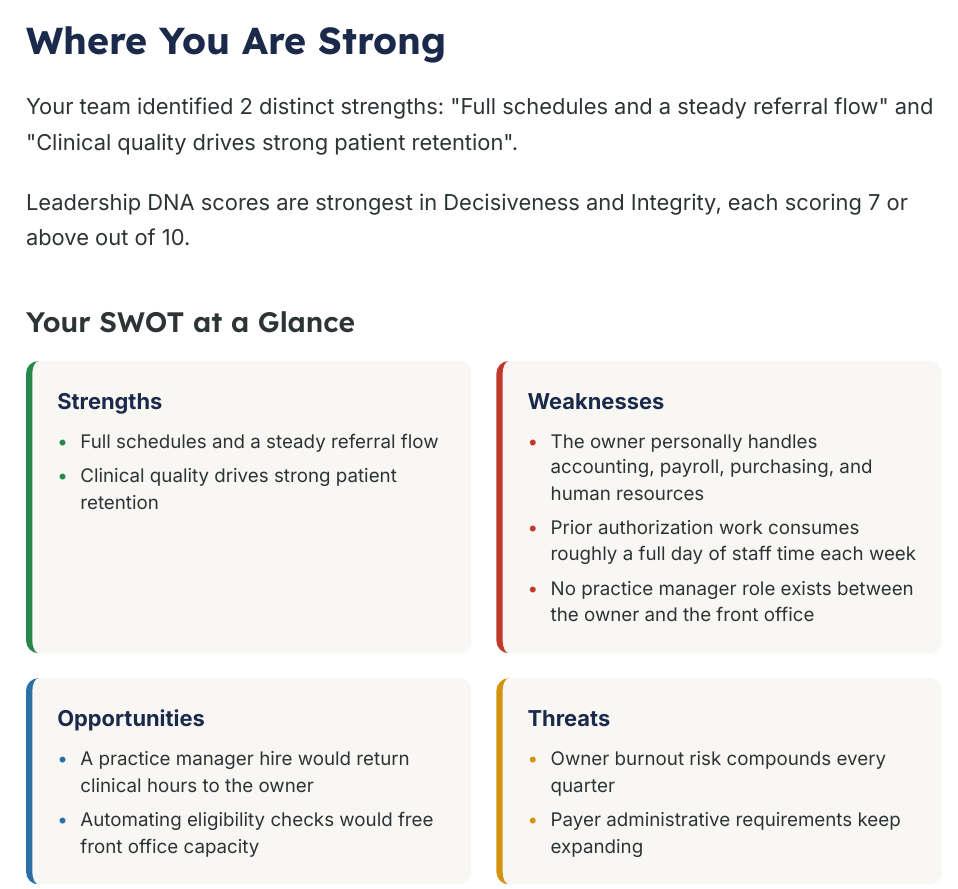
The weakness column reads like the complaint, formalized. The owner personally handles accounting, payroll, purchasing, and human resources. Prior authorization work consumes roughly a full day of staff time each week. No practice manager role exists between the owner and the front office.
The strengths column matters just as much. Full schedules, steady referrals, and strong patient retention mean demand is not the problem.
The threat column names the deadline: owner burnout risk compounds every quarter, while payer administrative requirements keep expanding. A practice like this is not failing. It is succeeding on a structure that consumes its owner, and success is what hides the bill.
The prioritized recommendations page is where the tool pushes back on the obvious fix.
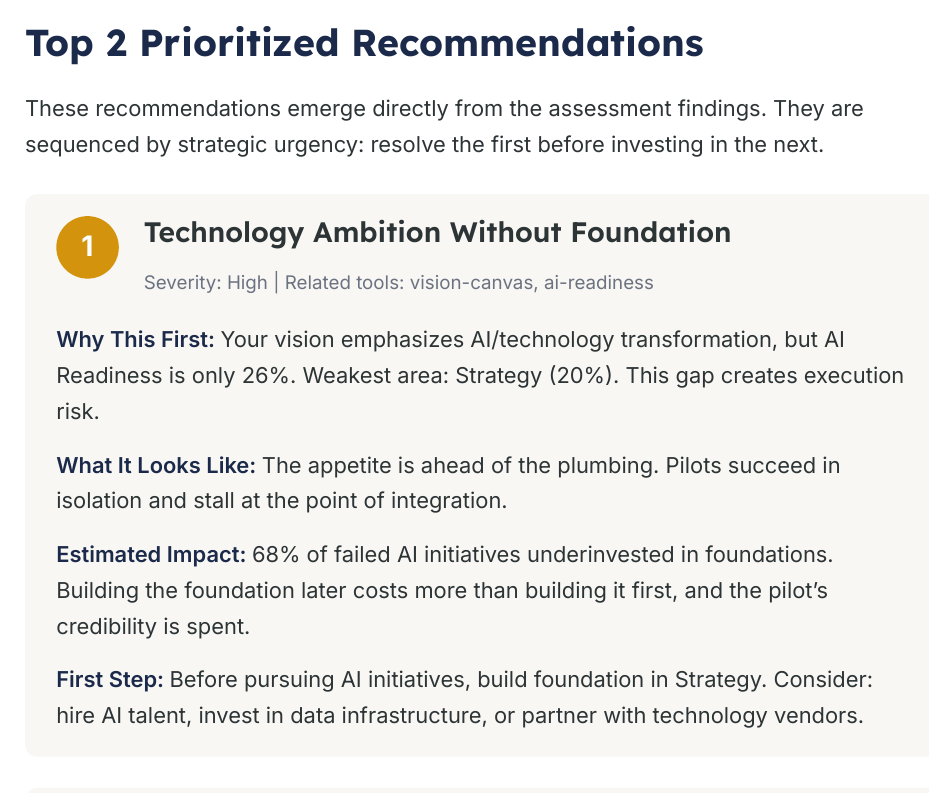
The persona’s vision leaned on automation to escape the admin load, and the assessment flagged exactly that: technology ambition without foundation, severity high. AI Readiness scored 26 percent with Strategy as the weakest area at 20 percent. The plain-language line lands hard: the appetite is ahead of the plumbing, and pilots succeed in isolation then stall at the point of integration.
That sequencing insight is the answer most advice skips. An owner drowning in admin work wants to automate first. The tool says the foundation, meaning defined processes and a management layer, has to exist before automation has anything to attach to.
What the Written Diagnostic Added
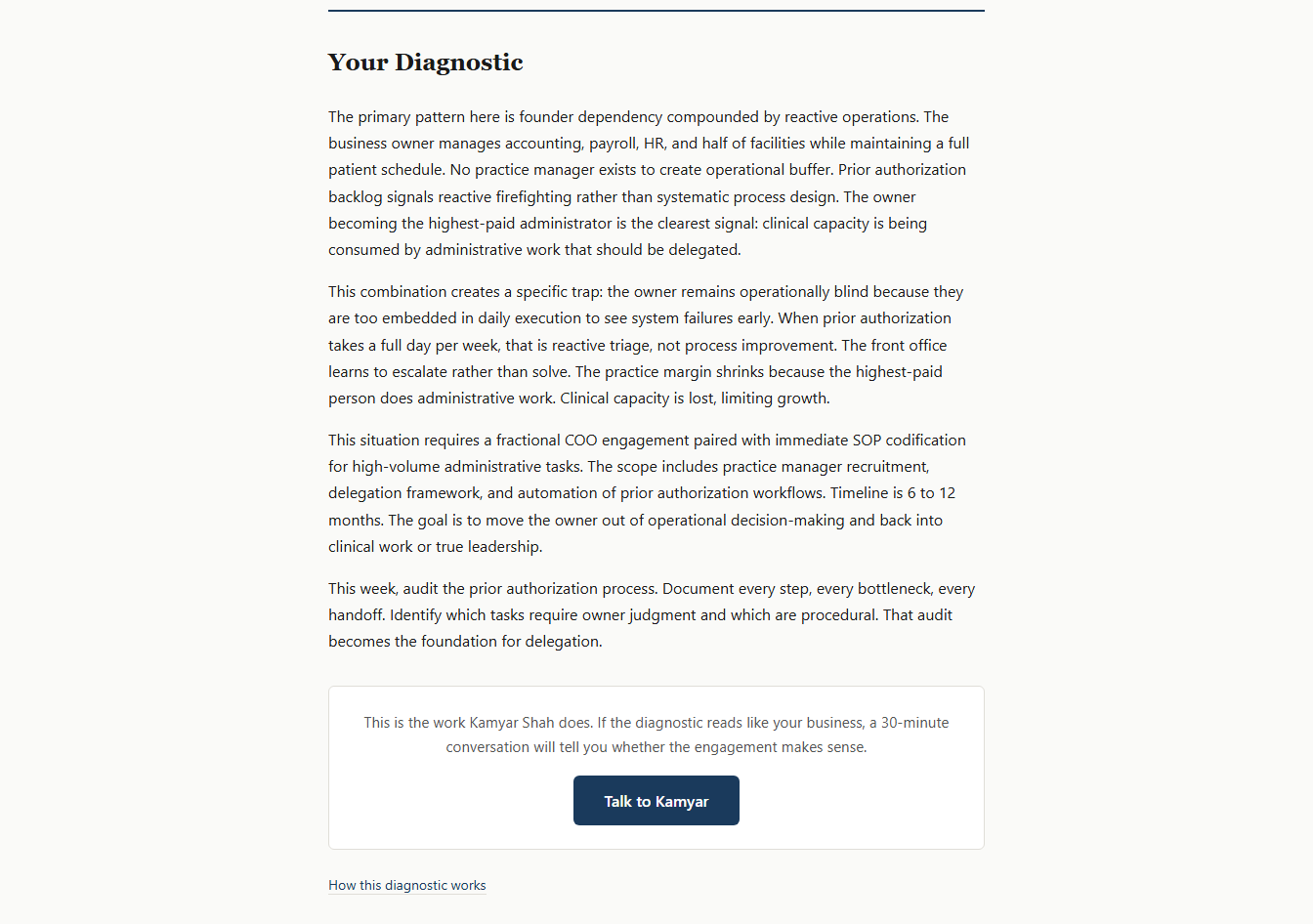
The written diagnostic named the pattern: founder dependency compounded by reactive operations. It also produced the line this article is named for. The owner becoming the highest-paid administrator is the clearest signal that clinical capacity is being consumed by work that should be delegated.
It also explained why the situation persists. The owner remains operationally blind because they are too embedded in daily execution to see system failures early. A full day per week of prior authorization is reactive triage, not process improvement. The front office learns to escalate rather than solve.
Its homework assignment is concrete. Audit the prior authorization process this week. Document every step, every bottleneck, and every handoff.
The point of the audit is the sorting, not the paperwork. Identify which tasks require owner judgment and which are procedural. That sorted list becomes the foundation for delegation, because nobody can hand off work that has never been named.
The Answer the Tools Assembled
Read together, the two outputs give the admin-absorbed owner a specific order of operations.
Separate judgment from procedure first. The prior authorization audit is the template: list what genuinely requires the owner’s judgment, and what is procedural work wearing the owner’s calendar. In most practices the honest split runs near 20 percent judgment, 80 percent procedure. Founder dependency survives on the refusal to make that split explicit.
Install the management layer second. A practice manager between the owner and the front office is not overhead. It is the structure that makes every later fix possible. The assessment listed the hire as the top opportunity because it returns clinical hours, the practice’s highest-margin asset.
Automate third. Once processes are documented and owned, automation of eligibility checks and authorization workflows has something to attach to. Run in the reverse order, the same tools become shelfware with a subscription fee. Operations consulting exists largely because businesses run this sequence backward.
The industry numbers say the clock is real. American Medical Association survey data across 1,000 physicians puts prior authorization at roughly 13 hours per physician practice each week, and 40 percent of practices staff someone exclusively for it. Meanwhile AMA benchmark data shows physician practice ownership fell from 60.1 percent to 42.2 percent, and admin-consumed owners are exactly who consolidators buy out.
The 90-Day Sequence
Days 1 to 10. Run the prior authorization audit as prescribed. Every step, every handoff, judgment tagged apart from procedure. Post the split where the team sees it.
Days 11 to 30. Extend the same audit to accounting, payroll, purchasing, and HR. Write the one-page process for each procedural block. The owner writes none of them: the person currently doing the escalating writes the draft, and the owner corrects it once.
Days 31 to 60. Hire or promote the practice manager. Hand over the documented procedural blocks with explicit decision rights, including a spending threshold and an escalation path.
Days 61 to 90. Now evaluate automation for eligibility and authorization workflows against the documented process. Measure owner admin hours weekly. The target the persona set, under 8 hours per week, is aggressive and achievable once the layer below exists.
Run the Same Diagnosis on Your Business
The walkthrough used a fictional practice. The tools accept real inputs and return the same class of findings, sequenced by severity. The VWCG Strategic Assessment takes about 10 minutes and returns a scored briefing with the recommendation order built from your own answers.
An owner who spends every evening on paperwork does not have a work-ethic problem. The structure is billing its most expensive hours to its least valuable work, and structure is fixable.
Kamyar Shah has led 650+ consulting engagements, including fractional COO, fractional CMO, executive coaching, and strategic advisory, producing over $300M in client impact across companies in the $1M-$50M range. He built the VWCG Strategic Assessment from the same diagnostic frameworks he uses in paid engagements.
Ready to assess your business?
Get clear visibility into your gaps with our free tools.
Start Free Assessment