Delegation That Comes Back: Why Handoffs Fail Without a Review Framework
An owner posted this to r/smallbusiness in August 2026. “I’m still the bottleneck for hiring, sales, and a bunch of day-to-day stuff that should be delegated by now.” Every owner who has tried to delegate recognizes the rest of that story. The work goes out, quality slips, the work comes back, and the lesson learned is the wrong one: nobody can do it like the owner can.
Small professional firms run the most expensive version of this loop. A managing partner hands a client matter to an associate. The draft comes back below standard, the partner rewrites it at midnight, and the next matter never leaves the partner’s desk. Meanwhile the associate reads the rewrite as a verdict on their future and starts returning recruiter calls.
The standard advice says delegate more and trust your people. That advice fails because it treats delegation as a personality trait. Delegation is infrastructure. When handoffs fail repeatedly, something structural is missing, and it is usually the same thing.
Testing the Question Against Real Tools
A fictional composite firm goes through the full diagnostic process below. Business and Estate Law Firm bills about $2M with 11 people. Hiring, business development, and daily operations all route through the managing partner.
Delegated matters come back after quality slips. Two associates have left in three years, both citing the same reason on the way out.
Every detail is invented, built from the sourced complaint above. The tool output is real. The VWCG Strategic Assessment returns a scored briefing from structured inputs. The businessconsultant.services diagnostic returns a written analysis from a plain-language description.
What the Assessment Found
The briefing dedicates a page to contradictions: places where stated intentions conflict with observed behavior. For this firm it found two.
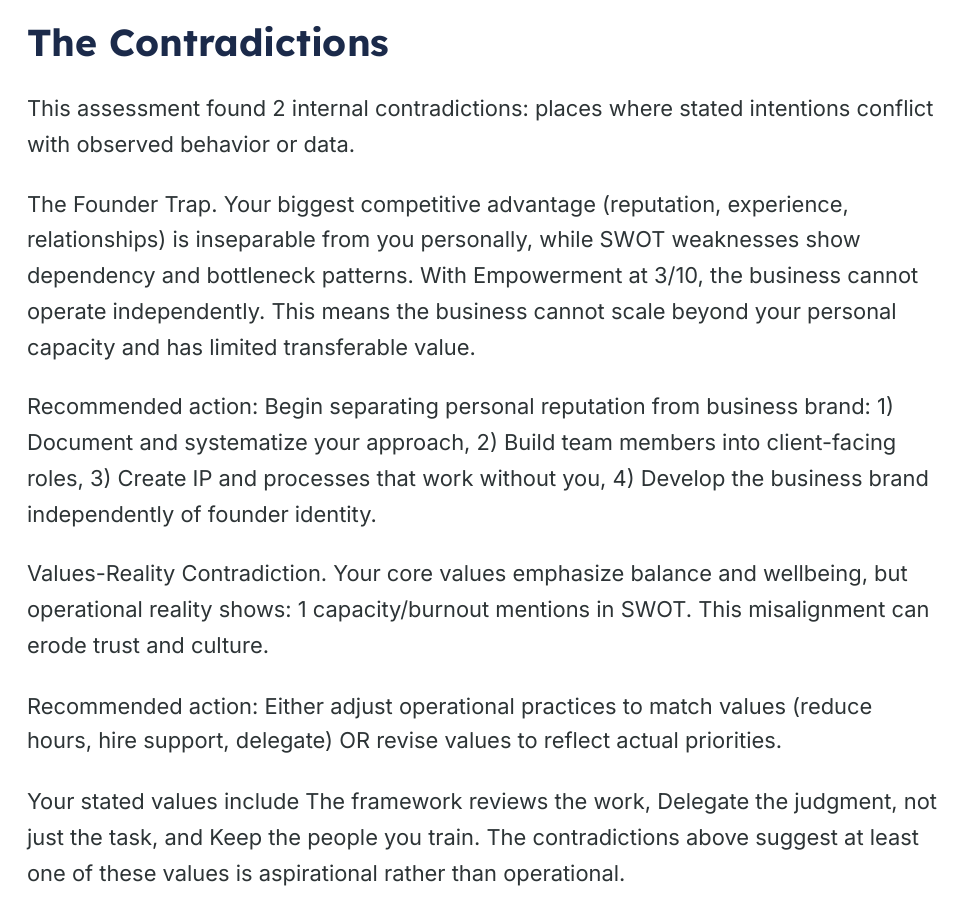
The first is the Founder Trap. The firm’s biggest competitive advantage, meaning reputation, experience, and relationships, is inseparable from the partner personally, while the SWOT weaknesses show dependency and bottleneck patterns. With Empowerment at 3 out of 10, the briefing concludes the business cannot operate independently, cannot scale beyond one person’s capacity, and has limited transferable value.
The second contradiction is sharper. The firm’s stated values include “The framework reviews the work” and “Keep the people you train.” The assessment’s verdict on that page: at least one of these values is aspirational rather than operational. The partner wrote the cure into the values and never built it.
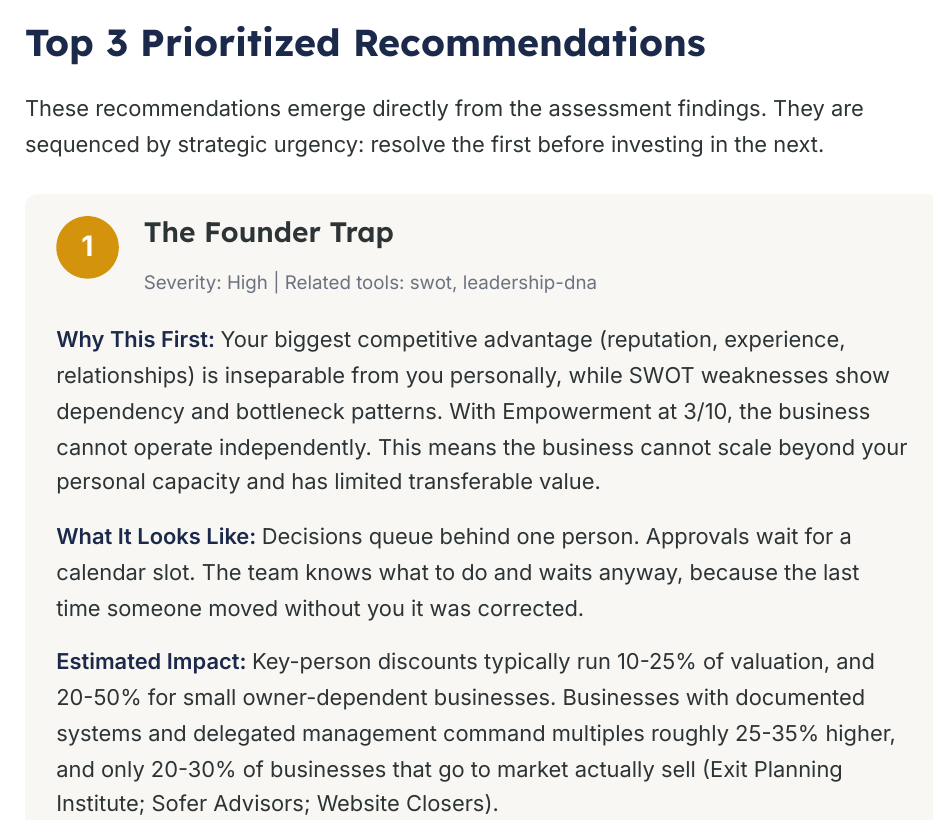
The prioritized recommendation page ranks the Founder Trap first, severity high. Its description of daily life is uncomfortably specific.
Decisions queue behind one person. Approvals wait for a calendar slot. The team knows what to do and waits anyway, because the last time someone moved without the partner it was corrected.
The briefing also estimates what the pattern costs at exit, citing key-person discounts of 10-25% of valuation and steeper for small owner-dependent firms. The numbers on that page belong to the tool’s sources. The structural point stands on its own: a firm that cannot run without its partner is worth less to everyone except the partner’s calendar.
What the Written Diagnostic Added
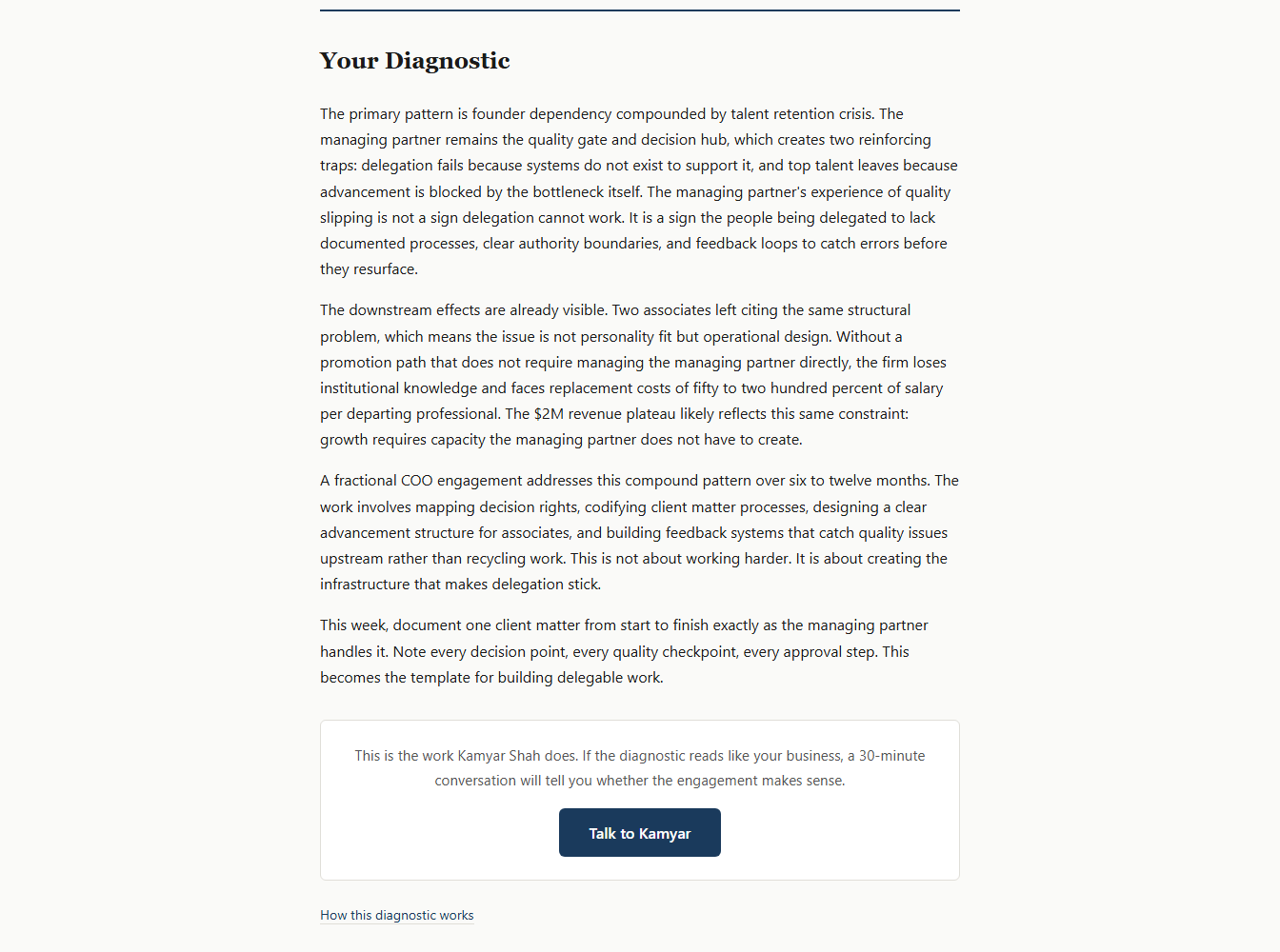
The written diagnostic connected the two halves of the complaint. The pattern is founder dependency compounded by a talent retention crisis. The traps reinforce each other: delegation fails because systems do not exist to support it, and top talent leaves because advancement is blocked by the bottleneck itself.
Then it reframed the evidence the partner keeps citing. Quality slipping after a handoff is not a sign delegation cannot work. It is a sign the people receiving the work lack documented processes, clear authority boundaries, and feedback loops that catch errors before they resurface. Two associates leaving with the same explanation means the issue is operational design, not personality fit.
Its homework is the template for everything that follows. Document one client matter from start to finish exactly as the partner handles it. Note every decision point, every quality checkpoint, and every approval step. That document becomes the first delegable unit of work.
The Answer the Tools Assembled
The complaint asked why work that should be delegated by now is not. The combined answer: because the firm delegates tasks while retaining the judgment, and judgment was never written down.
Write the review framework first. For each matter type, define what a complete work product contains, what a reviewer checks, and what triggers escalation. The framework reviews the work, so the partner does not have to. This is the difference between documented processes that run and documentation that decorates a shared drive.
Delegate the judgment with the task. A handoff that transfers activity but not decision criteria always comes back. State the quality bar, the common failure points, and the boundaries of the associate’s authority. Then let the framework, not the partner’s midnight rewrite, deliver the verdict.
Build the advancement path outside the bottleneck. Associates stay where mastery accumulates into ownership. NALP data shows associate attrition at firms of 100 or fewer attorneys runs 24 percent, against 16 to 18 percent at larger firms. Small firms lose the people they train precisely because every path runs through one person, and growth decisions made alone keep it that way.
The 90-Day Sequence
Days 1 to 10. Document one matter end to end, as prescribed. Decision points tagged, quality checkpoints named, approval steps counted. This is the master template.
Days 11 to 30. Convert the template into a review framework for the two highest-volume matter types. One page each: definition of done, reviewer checklist, escalation triggers.
Days 31 to 60. Run every new matter of those two types through associate ownership with framework review. The partner reviews the framework’s output, not the raw work. Track rework rate weekly.
Days 61 to 90. Publish the advancement path. Which competencies, demonstrated through framework-passed matters, unlock client-facing ownership. The measure the persona set, 80 percent of matters closing without partner rework, is the number that tells the firm delegation finally sticks.
Run the Same Diagnosis on Your Business
The walkthrough used a fictional firm. The tools accept real inputs and return the same class of findings, including the contradictions page most owners cannot see from inside. The VWCG Strategic Assessment takes about 10 minutes and scores delegation directly through its Leadership DNA module.
Work that comes back was never fully delegated. It was loaned, with the judgment held in reserve. Write the judgment down and the work stays gone.
Kamyar Shah has led 650+ consulting engagements, including fractional COO, fractional CMO, executive coaching, and strategic advisory, producing over $300M in client impact across companies in the $1M-$50M range. He built the VWCG Strategic Assessment from the same diagnostic frameworks he uses in paid engagements.
Ready to assess your business?
Get clear visibility into your gaps with our free tools.
Start Free Assessment